Tuesday, March 29, 2011

Mame shibori explained (video)


(click image to redirect to video clip)

Mame ("beans") shibori is a classically Edo design, a pea-dot pattern most common for tenugui (hand towel).

Harisho, the only remaining itajime master continuing practice of this traditional Edo period technique, demonstrates on video how to fold fabric several times into very small strips then put in between carved wooden boards (for mame, the boards are grooved). Recently, Harisho collaborated with popular Japanese fashion brand SOU.SOU, providing fabrics for their contemporary tabi collection.

Mame fabric created by Harisho is available in Yoshiko's online shop.

Thanks for sharing, Barbara Shapiro!

Monday, March 21, 2011

SCARF exhibition by WSN-Australia + NZ photos!

Back in August we blogged about SCARF, a traveling exhibition featuring shaped resist dyed scarves and shawls created by members of WSN Australia and New Zealand. It's now made its way to Strathnairn Arts Association (thru April 3) where Barbara Schey gave a talk at the opening reception on March 11. I sneaked a peek* at a couple snapshots taken by our indefatigable Secretary General of WSN Australia, Joan James. Here are a few photos:

*thanks to good old Facebook

(top) Barbara Schey gives remarks at opening reception, Kevin Schamburg stands nearby;
(middle, bottom) pieces from SCARF exhibition at Straithnarn Arts Association.
All photos courtesy Joan James


Inspiring & humbling: a letter from Sendai, Japan

A bit of inspiration from the disaster in Japan. This is a personal account written by Anne Thomas, who lives in Sendai. Thanks to Masako for forwarding to us. (Originally published online at Ode magazine)


A Letter from Sendai

Anne Thomas 3/14/2011

Things here in Sendai have been rather surreal. But I am very blessed to have wonderful friends who are helping me a lot. Since my shack is even more worthy of that name, I am now staying at a friend’s home. We share supplies like water, food and a kerosene heater. We sleep lined up in one room, eat by candlelight, share stories. It is warm, friendly, and beautiful.

During the day we help each other clean up the mess in our homes. People sit in their cars, looking at news on their navigation screens, or line up to get drinking water when a source is open. If someone has water running in their home, they put out a sign so people can come to fill up their jugs and buckets.

It’s utterly amazingly that where I am there has been no looting, no pushing in lines. People leave their front door open, as it is safer when an earthquake strikes. People keep saying, “Oh, this is how it used to be in the old days when everyone helped one another.”

Quakes keep coming. Last night they struck about every 15 minutes. Sirens are constant and helicopters pass overhead often.

We got water for a few hours in our homes last night, and now it is for half a day. Electricity came on this afternoon. Gas has not yet come on. But all of this is by area. Some people have these things, others do not. No one has washed for several days. We feel grubby, but there are so much more important concerns than that for us now. I love this peeling away of non-essentials. Living fully on the level of instinct, of intuition, of caring, of what is needed for survival, not just of me, but of the entire group.

There are strange parallel universes happening. Houses a mess in some places, yet then a house with futons or laundry out drying in the sun. People lining up for water and food, and yet a few people out walking their dogs. All happening at the same time.

Other unexpected touches of beauty are first, the silence at night. No cars. No one out on the streets. And the heavens at night are scattered with stars. I usually can see about two, but now the whole sky is filled. The mountains are Sendai are solid and with the crisp air we can see them silhouetted against the sky magnificently.

And the Japanese themselves are so wonderful. I come back to my shack to check on it each day, now to send this e-mail since the electricity is on, and I find food and water left in my entranceway. I have no idea from whom, but it is there. Old men in green hats go from door to door checking to see if everyone is OK. People talk to complete strangers asking if they need help. I see no signs of fear. Resignation, yes, but fear or panic, no.

They tell us we can expect aftershocks, and even other major quakes, for another month or more. And we are getting constant tremors, rolls, shaking, rumbling. I am blessed in that I live in a part of Sendai that is a bit elevated, a bit more solid than other parts. So, so far this area is better off than others. Last night my friend’s husband came in from the country, bringing food and water. Blessed again.

Somehow at this time I realize from direct experience that there is indeed an enormous Cosmic evolutionary step that is occurring all over the world right at this moment. And somehow as I experience the events happening now in Japan, I can feel my heart opening very wide. My brother asked me if I felt so small because of all that is happening. I don’t. Rather, I feel as part of something happening that much larger than myself. This wave of birthing (worldwide) is hard, and yet magnificent.

Thank you again for your care and Love of me,

With Love in return, to you all,

Anne

Friday, March 18, 2011

Oscar de la Renta, Shabd gets in on shibori


Like Proenza Schouler, fashion heavyweight Oscar de la Renta gets shibori-tied with his Spring Summer 2011 collection. And Brooklyn-based newcomer Shabd bases her whole line on shibori, deftly using it to a wonderfully subtle watercolor effect. Dreamy...
(images: (top) Oscar de la Renta shibori chiffon caftan dress; (bottom) shabd blue marble geode dress)

Wednesday, March 16, 2011

Message from Yoshiko re: Japan & Fundraiser

A note from Yoshiko and information on a fundraiser, "Handmade for Japan".
-------------

Dear Friends,
Thank you for your emails of concern regarding Japan and our friends there. I caught the news of the earthquake while at the Delhi Airport waiting for my flight home from India.

I have spoken with some of our friends and family in Kiryu in Gunma Prefecture, Tokyo, even in Fukushima Prefecture and other parts of Japan and found them all fine and calm. But the pending nuclear disaster is the biggest concern for all.

Foods and gasoline have become scarce and some friends in the greater Tokyo area are trying to flee to the West. Our papermaker friend, Mr. Shio -- who accompanied me on my recent trip to India -- was in Tokyo at a tradeshow at a big convention center near the Tokyo Bay
when the earthquake struck. Having lived through a large earthquake that hit his hometown of Tottori several years back, Mr. Shio knew immediately what to do: he took off running to higher ground. Everyone started following him up to the roof. Thankfully, the tsunami didn't hit. After miles of walking, he found an open metro line to Haneda airport and flew back home to the Japan Sea Coast in the western part of Honshu Island (away from the affected area though there is another nuclear power plant in Shimane Prefecture not too far from them).

The upcoming SFS program in Japan in May/June, fortunately, does not include Miyagi, Iwate, or Fukushima Prefectures and the destinations are not affected by the devastation at the moment.

Let us pray that the worst will be avoided at the nuclear power plant.
Thank you all for your concerns.

Yoshiko

---------------

A Japan fundraiser has been organized by ceramist Ayumi Horie and friends -- "HANDMADE FOR JAPAN" is an eBay art auction starting Thursday, 8p EST. All proceeds will go to Global Living. Learn more about the auction here.

Monday, March 7, 2011

The Reinvention of Silk (NYT, Mar 7 2011)

"The Reinvention of Silk," an article published in today's New York Times, discusses new, outside-the-box creations of this versatile filament. Since spider's can't spin enough of it, "some scientists are ... working on reinventing the one silk that is commonly available — that of silkworms. They are reconstituting it to make novel materials that have the potential to go far beyond the dream of bulletproof vests." Read full article here

(above) Silk creations by Tufts University researchers include a coilmade of silk substrate and gold that can help tell when food goes bad.

(above) Pure silk fibroin powder used to make solvent-based silk scaffolds that take a long time to degrade in the body.
Photo credits: Bryce Vickmark, for the NYT


Thursday, February 17, 2011

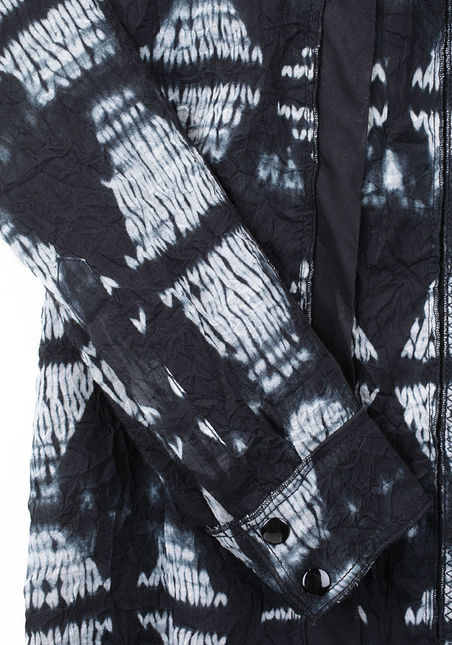
Proenza Schouler's SS11 collex brings "shibori" to fashionista lexicon

Bergdorf Goodman helps introduce the word "shibori" to the well-heeled set.

Fashion darlings, Jack McCollough and Lazaro Hernandez, who head the high-end designer label, Proenza Schouler, are bringing shibori into fashionable closets across the country with their SS11 collection. What's more? They are actually calling it by its name: SHIBORI. Now, that's a first. Read the description from Bergdorf's below.
Count this as a win, folks.
Shibori Chiffon Dress

Familiar elements come together in unfamiliar ways on this Proenza Schouler dress.
The foundation for this innovation is shibori, a traditional Japanese dye
technique similar to tie dye—but different in subtle, important ways.

More from the collection.


voile shirtdress "with diamond print" (left) and shirtdress in "sunburst print" (below) available at La Garconne


Tuesday, January 11, 2011

News from Around...

In 2011, I wanted to post with more regularity on the blog (we'll see how that goes) and that includes highlighting work from some of our readers -- some new to shibori and some very seasoned. It's always a thrill to hear from people who have just begun experimenting with shibori in all its complexities and to seethis technique inspire more people. So, with that, let's begin...

irresistible resist
Shipra writes to us from India: I got interested in Shibori after a workshop I took in Jaipur. I, along with my friend, started practising it, mostly from Ms. Wada's book. It has been very enriching experience. We have been practising it for last one and a half year. I am thankful to you for amazingly informative book and a lovely website. www.irresistibleresist.blogspot.com

-----------
SUZUSAN.e.K. featured in Stijlvol Wonen
Popular Dutch shelter magazine "Stijlvol Wonen" (Stylish Living) recently featured shibori lamps produced by Hiroshi Murase from his line, SUZUSAN.e.K. Very stylish, indeed. www.suzusan-shibori.com


-------------
Michelle Victoria McGrath
Michelle Victoria McGrath is a graduate from the University of Wales Newport. A few years ago, she gave up her full time job as a teacher to pursue her dream of becoming a fashion designer. Three years of schooling later, she won the Ryder Cup Fashion Show competition and training with Paul Costelloe in LFW 2011. Michelle is currently setting up her own label, MVM, which will be based in Wales. www.michellevictoriamcgrath.com
-----------
Paris American Academy
And a final note from our wonderful friend, Peter Carman, Director of Paris American Academy (PAA) and former host of the ISS in France (2008). They launched a new website and it looks GREAT! If ever you're in Paris and want to see a top-notch fashion academy, head to PAA. And before you do, see what new things might be happening: check out their Current Events section on the web. www.parisamericanacademy.fr

Monday, January 10, 2011

Remembering Mary Kellogg Rice

Celebrating Mary Kellogg Rice
Artist, Author, Supporter of Crafts


It is with sadness that I write about the recent passing of Mary Kellogg Rice, a beautiful spirit and accomplished woman who lived a rich and full life. She had just celebrated her 100th birthday in December 2010.

Among her many contributions to the community and art world, Mary co-authored "Shibori: The Inventive Art of Shaped Resist Dyeing" with me and Jane Barton, a seminal book in my professional career and for the art of shibori and textile design in general. Mary was also involved in the WPA during the Great Depression, serving as art director for the Milwaukee State Teachers College where women were taught weaving, block-printing, quilting, and other crafts. She recorded her experience in her second book, "Useful Work for Unskilled Women: A Unique WPA Project," which earned a 2004 Wisconsin State Historical Society Book Award of Merit.

A private gathering will be held for only family and close friends. Thank you.

Thank you, Mary, for all that you did for the textile and crafts community over the last 100 years. You were a wonderful colleague and friend.

Warm regards,
Yoshiko
Mary's co-author and President of the World Shibori Network


Tuesday, January 4, 2011

Workshop: baandhani & leheria with kamaldeep kaur (May 2011, netherlands)

Baandhani & Leheriya:
reviving traditional Indian resist dyeing techniques

3-day workshop with Kameldeep Kaur (India)

- 19, 20, 21 May 2011 -
studio zijdelings
netherlands

India has been known since antiquity for amazing handcrafted textile techniques. Resist dyed and printed textiles have long been a popular Indian export with Gujarat and Madras serving as two important ports and producing centres for Dutch and British companies.

KAMALDEEP KAUR will instruct a 3-day workshop on the age-old techniques and patterns of baandhani and leheriya using natural dyes, such as madder, daru haldi, and lac.
Kamaldeep is a noted researcher from India who has been involved in the revival of several traditional techniques as well as the continuation of existing crafts through design consultancy and product development.

Day 1. The course begins with the story of baandhani and leheriya: a brief introduction with images of process, wearers, makers, surroundings, and traditional and contemporary products. Next is instruction in leheriya on finer silk fabric, which we will prepare and soak overnight for you. Once tied, the samples can be dyed with madder the very same day. You will be able to make several different samples. Some of the samples can be opened, then re-tied and re-dyed the next day for two colour effects.

Day 2. Morning begins with a presentation on natural dyes, followed by preparing daru haldi. We continue with baandhani tying and dye at the end of the day.

Day 3. The final day is devoted to lac dyeing. Morning starts with tying, then working in groups near the dye bath to talk about how to develop it. Samples tied today can be full scarves rather than smaller swatches. We may do two different lac dye baths (time permitting): one with tamarind and one with vinegar to show the difference in brightness of colour. We may also use different mordants to yield different shades.


This class will be in English.
Coffee / tea & lunch will be provided.

DATES: 19,20,21 May 2011, 10am-5pm

COURSE FEE: € 300,00 excluding materials. There will be an additional lab fee for natural dyes and Indian silk

LOCATION: Studio Zijdelings Tilburg - The Netherlands

INSTRUCTOR: Kamaldeep Kaur, India

CONTACT: Karina van Vught www.zijdelings.com